Quintel Blogger theme

A free Premium Blogger theme.

Showing posts with label American Red Cross-North Texas Region. Show all posts

Monday, February 10, 2014

I Cross My Heart


Photo courtesy of American Red Cross
by Sydney Holt, volunteer contributor

“I Cross My Heart” – A promise, playground rhyme and a familiar country tune, the saying “I cross my heart” is one that we associate with the truth or a pledge. When it comes to taking the pledge to volunteer, I think many of us become overwhelmed and let our commitments fall by the wayside between school, work, parenting and all the other roles we take on as productive members of society. Well, listen up because do I have news for you… Volunteering can be what YOU make it!

Don’t believe me? 30 minutes, a few hours, part-time – take a look at a few ways you can volunteer with DFW Red Cross in 2014 – I “Cross My Heart” it’ll be quick!

30 – 45 minutes – Donate Blood. Contribute to your community's blood supply and change lives. Do it on your own schedule, volunteer as much as and as often as your schedule permits.

A few hours - Learn CPR or Become a Red Cross Instructor. Be ready to serve your community (and loved ones) at any time by learning the important skill of CPR. Then take it to the next level by attending additional courses to become a certified Red Cross Instructor. The Red Cross also offers other life-saving training classes, including Lifeguarding, Babysitting & Swimming/Water Safety.

More flexible – Admin work, accounting experience, writing experience – we welcome all of your talents! To search for opportunities in the DFW area (and beyond) click here.

No time? Don’t feel bad – be a financial participant by donating $10 – text ‘redcross’ to 90999.

Tuesday, January 3, 2012

How Do You Aspire to Change the World in 2012?

Originally posted December 29, 2011 on redcrosschat.org by Gail J. McGovern

Editor’s note: This post is a response to Craig Newmark’s Social Good Blog Series call for posts on the topic, “How Will You Change the World in 2012?”.

Joplin Tornado 2011
Gail McGovern talks to Adebayo Oguntayo at an aid station during her visit to the tornado hit areas in Joplin, MO on May 28, 2011.

From the tornadoes in Joplin, Miss., to the earthquake and tsunami in Japan, this past year has been marked by devastating and deadly disasters that have killed thousands of people, destroyed whole communities and changed lives forever. It was one of the worst years for disasters, but it brought out the best in millions of people who gave generously to support their neighbors down the street, across the country and around the world.

When people talk about changing the world, many will say it’s impossible, but I must disagree. I have been privileged to see first hand how the work of an organization like the American Red Cross can change the world for the better.

When the American Red Cross can help build temporary homes and hospitals in Japan, we have changed the world for the survivors who lost everything.

When one billion children in 60 countries have been vaccinated against measles, their world has been changed. When a cancer patient or accident victim receives a life-saving blood transfusion, their world has been changed.

When a family’s house burns down in the middle of the night, and Red Cross volunteers arrive with a warm cup of coffee, a blanket for their shoulders, a place for them to stay and a plan to help them get back on their feet, their world has been changed.

There are stories after stories of the many ways the American Red Cross changes lives every day.


In 2012, I aspire to change the world by doing everything in my power to engage more Americans in our mission and to help more people in need.


In the coming year, the Red Cross will be on the ground in Haiti continuing to build homes, support cholera prevention, create job opportunities for Haitians and increase access to clean water.

As the largest supplier of blood products in the U.S., we’ll be supporting the evolution of cellular therapy for treating diseases, like advanced prostate cancer, as well as leading research on blood transfusions in the area of emerging diseases.


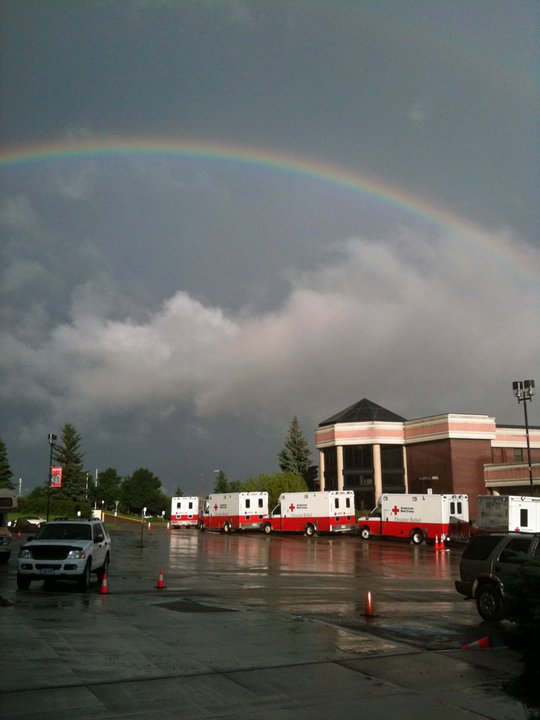
Right: Emergency Response Vehicles helping with flood recovery in Minot encountered a rainbow after a thunderstorm passed through.

In 2012, we will continue to stand ready 24/7 and will strive to provide flawless disaster relief whenever and wherever a disaster strikes. Every year we respond to about 70,000 disasters, from large-scale events likeHurricane Irene, to a single-family house fire. Every nine minutes we’re on the job somewhere around the country offering disaster victims food and shelter, a shoulder to lean as they face an uncertain future, and resources to help them recover.

As more and more of our service members return home from deployments, the Red Cross will be there to help them reconnect with their families and communities; and we will continue to help support those in military hospitals along with their families, especially through our new partnership with the Wounded Warrior Project.

We’ll also be looking at ways to make our first aid and CPR classes more accessible to the public this year. Our goal is to train 5 million people in hands-only CPR so they, too, can save a life.

Save a Life Saturday (NJ)
Red Cross chapters held Save a Life Saturday classes at more than 100 locations across the country to honor Rep. Gabrielle Giffords and all those involved in the Tucson, AZ tragedy.

In 2012, I will strive to continue to ensure that our donors approve of how we’re using their precious gifts. We are proud that an average of 91 cents of every dollar the Red Cross spends goes to our humanitarian services and programs. In September, we were gratified to learn that Charity Navigator, a watchdog group for charities, awarded us four out of four stars for fiscal health, accountability and transparency.

Our work does change the world by offering the priceless gift of help, hope and compassion to people in urgent need. But we cannot do it without your help. I invite you to join us in 2012. There are so many simple ways you can make a difference.Donate blood. Make a financial contribution. Sign-up to volunteer.

I would be honored to work alongside you to change the world, and I know it can be done because I see it happen every day at the Red Cross.

Monday, November 21, 2011

Safety First during Holiday Travel

Millions of travelers will take to the skies, rails and highways during the Thanksgiving holiday and the American Red Cross offers some tips to help travelers arrive safely at their destination.

Airports, bus and train stations are crowded with Thanksgiving travelers, but most holiday travelers use highways and biways. Many people even make same-day trips to visit friends and family just for the day.

To arrive safely, the Red Cross recommends these steps for those driving to visit loved ones:
  • Make sure your vehicle is in good working order. 
  • Start out with a full tank of gas, check the air pressure in your tires and make sure you have windshield fluid. 
  • Buckle up, slow down, don’t drive impaired.
  • Be well rested and alert.
  • Use caution in work zones.
  • Give your full attention to the road. Avoid distractions such as cell phones.
  • Observe speed limits – driving too fast or too slow can increase your chance of being in a collision.
  • Make frequent stops. During long trips, rotate drivers. If you’re too tired to drive, stop and get some rest.
  • Be respectful of other motorists and follow the rules of the road.
  • Don’t follow another vehicle too closely.
  • If you plan on drinking, designate a driver who won’t drink.
  • Clean your headlights, taillights, signal lights and windows to help you see, especially at night.
  • Turn your headlights on as dusk approaches, or if you are using your windshield wipers due to inclement weather.
  • Don’t overdrive your headlights.
  • If you have car trouble, pull off the road as far as possible.

It’s also recommended that you keep an emergency preparedness kit in the vehicle. Useful items include water, snacks, a flashlight, first aid kit, extra cash and blankets. The Red Cross Deluxe Auto Safety Kit is a great solution to help people prepare for emergencies on the road and is available in the Red Cross Store at http://www.redcrossstore.org./
 
For people traveling by air, bus or train, the Red Cross reminds them that the seasonal flu can occur as early as October. If you have come in contact with someone who is sick, perhaps the trip should be postponed as you may be contagious for a week before symptoms appear.
 
Other safety tips to avoid the flu while you travel include the following:
  • Remember that everything you touch has to be touched by someone else – luggage handlers, etc. Handle your own belongings as much as possible. Wash your hands often with soap and water.
  • Carry hand sanitizer and anti-bacterial wipes with you. You can use them to wash your hands or wipe down surfaces such as armrests.
  • Bring your own pillows and blankets – they can act as a shield against the seat itself.
  • If you have to cough or sneeze, do so into a tissue or your sleeve.
  • Avoid touching your face or eyes.

For more information on how to remain safe while traveling this Thanksgiving, visit http://www.redcross.org/.

Saturday, November 5, 2011

Turn The Clocks Back This Weekend And Check Your Smoke Alarms

This weekend we should all turn the clocks back one hour to mark the end of Daylight Saving Time, creating a blissful extra hour of sleep Sunday morning.

The American Red Cross recommends that everyone take the time to get prepared for fall and winter by checking their emergency preparedness supplies - a step that could save time during an emergency.

When turning the clocks back, people should also check the batteries in their smoke alarms, and make sure the alarms work by pushing the test button. It’s also a good time for everyone to check their carbon monoxide detectors. Folks should replace the batteries in both smoke and carbon monoxide detectors at least once a year.

Other steps people can take to get prepared include:
  • Updating the emergency contact information in their family communications plan. Choose an out-of-area emergency contact that each person in the household can call if he/she becomes separated during a disaster situation.
  • Making sure their emergency preparedness kit still includes at least a three-day supply of non-perishable food items and water (one gallon per person per day), a flashlight, a battery-powered or crank radio, can opener, first aid kit, copies of important documents, and special items such as medications, diapers, and infant formula.
  • Checking their emergency preparedness kit for expired food items; refreshing staples such as water, food and batteries. If there have been changes in prescriptions or dietary needs, add new foods and medications as needed.
Taking simple actions like these can help people be better prepared for a disaster situation. More information on how families can get ready for an emergency is available on www.redcross.org So, when turning back the clock this weekend, people should take a few extra minutes to ensure that their loved ones are better prepared for the unexpected.

Friday, November 4, 2011

NASCAR takes "Race to Prepare" to Cross Timbers Middle School students

Photo by Grapevine-Colleyville Independent School District

Guest blog post by Grapevine-Colleyville Independent School District

Sixth-grade students at Cross Timbers Middle School got a special visit from NASCAR driver Denny Hamlin as part of a FedEx Racing “Race to Prepare” program at the school on Thursday. Approximately 250 students participated in an assembly presented by FedEx and the American Red Cross to teach students about the importance of being prepared for any emergency. As part of the program, 28 students competed in a “Race to Prepare” relay to build emergency kits containing items such as batteries, First Aid supplies, water, flashlights and whistles. Patti Davis, GCISD executive director of administration, kicked off the event with a district welcome. Guest speakers included Hamlin, driver of the #11 FedEx Toyota Camry; Kevin Sisk, senior manager of operations for FedEx Express; Leslie Palmer, interim chief executive officer of the American Red Cross North Texas Region; and Chief Steve Bass of the Grapevine Fire Department. Before the event, students were able to tour a vehicle display including an actual #11 FedEx Toyota Camry race car (now retired), a FedEx delivery truck, a Red Cross Hummer and a Grapevine fire truck.

“We are excited to be able to partner with FedEx and the American Red Cross to bring such a great program to our district,” Davis said. “GCISD has a comprehensive emergency management plan and we practice drills regularly to teach students how to respond to emergencies at school. Now, through this partnership, we are taking those efforts a step further to reinforce the importance of emergency preparedness at home and in our community.”

Each year, four cities from across the nation are selected to host a FedEx Racing “Race to Prepare” program in their community. The program works in conjunction with Red Cross efforts to educate and prepare the public for emergencies through the “Do More Than Cross Your Fingers” campaign. Both programs emphasize emergency preparedness through building emergency kits, creating a family communication and evacuation plans, and educating the community about disasters. Through this program, FedEx also announced a $10,000 donation to the North Texas chapter of the Red Cross to support local efforts throughout the community.

Friday, October 28, 2011

Veterans History Project

The Veterans History Project (VHP) collects and preserves the remembrances of American war veterans and civilian workers who supported them. These collections of first-hand accounts are archived in the American Folklife Center at the Library of Congress for use by researchers and to serve as an inspiration for generations to come. The Project collects remembrances of veterans who served in World War I, World War II, the Cold War, Korean War, Vietnam War, Persian Gulf War (1990-1995), or Afghanistan and Iraq conflicts (2001-present). U.S. citizen civilians who actively supported war efforts (such as war industry workers, USO workers, flight instructors, medical volunteers, defense contractors, etc.) are also invited to share their valuable stories. VHP relies on volunteers throughout the nation to collect veterans’ stories on behalf of the Library of Congress. These stories are made available to researchers and the general public, both at the Library in Washington, D.C., and via the Veterans History Project website.

The Department of Veterans Affairs Voluntary Service and the American Red Cross-North Texas Region are partnering to recruit and train volunteers in your community to collect veterans stories on be-half of the U.S. Library of Congress. Volunteers are needed to record the stories of Texas' 1.7 million veterans, before it is too late; more than 1,000 veterans die every day in the U.S.

We depend on people like YOU to record and submit first-person narratives by wartime veterans.

We are offering a FREE training for those in the community age 16+ wanting to become part of this historical project!

You're invited to join us at one of these locations:

American Red Cross North Texas Region
4800 Harry Hines Blvd
Dallas, TX 75235

November 4
8:30am—12:30pm
Lunch will be provided

RSVP To:
Brian Moeschler
972-632-2615
moeschlerb@usa.redcross.org

Fort Worth VA Outpatient Clinic
2201 SE Loop 820
Fort Worth, TX 76119

November 8th
8:30am—12:30pm
Lunch will be provided

RSVP To:
Bimal Chaudhry
817-730-0078
bimal.chaudhry@va.gov

Bonham VA
1201 E. Ninth Street
Bonham, TX 75418

November 16th
9:00am—1:00pm
Lunch will be provided

RSVP To:
Tina McDaniel
903-583-6282
tina.mcdaniel@va.gov

Wednesday, October 26, 2011

Halloween is Lurking Around the Corner

Red Cross tips help make it safe and less scary.

As ghosts and vampires get ready to roam the streets, the American Red Cross has tips to make this a frightfully safe Halloween.

Costume Safety

Whether a child wants to be a princess, a monster or a superhero for Halloween, parents can help keep it safe by:
  • Adding reflective tape to costumes and trick-or-treat bags.
  • Using flame-resistant costumes.
  • Using face makeup instead of masks, which can cover your eyes and make it hard to see.
Navigating the Neighborhood

To maximize safety, plan a route ahead of time. Make sure adults know where children are going. If the children are young, a parent or responsible adult should accompany them as they walk through the neighborhood.

Here are more safety tips to follow as children go from house to house:
  • Make sure trick-or-treaters have a flashlight.
  • Visit only the homes that have a porch light on. Accept treats at the door—never go inside.
  • Walk only on the sidewalks, not in the street. If no sidewalk is available, walk at the edge of the roadway, facing traffic.
  • Look both ways before crossing the street, and cross only at the corner.
  • Don’t cut across yards or use alleys. Don’t cross between parked cars.
  • Be cautious around strange animals, especially dogs.
Trick or Treat!

For those who expect to greet trick-or-treaters at their door, they can make sure it’s fun for everyone by following a few tips:
  • Make sure the outdoor lights are on.
  • Sweep leaves from sidewalks and steps.
  • Clear the porch or front yard of any obstacles that a child could trip over.
  • Restrain pets.
  • Use a glow stick instead of a candle in jack-o-lanterns to avoid a fire hazard.
Visit redcross.org for more advice on having a safe and fun Halloween.

Monday, October 24, 2011

Annual Volunteer Appreciation Family


Blog post by Elizabeth Murphy, Volunteer Retention Specialist for the American Red Cross

On Saturday, October 15, 2011, Mother Nature couldn’t have given us a better day to have the Annual Volunteer Appreciation Family Day. Nearly 100 members from our local American Red Cross family came out to the Dallas Office to bounce around in the tropical bouncy house, play carnival games, eat mega-yummy food from Jacks ChowHound and rock out to Hackberry Road.

With Halloween right around the corner, everyone took a turn dressing up in our vintage Red Cross uniforms to have their photo snapped.

Jacks Chow Hound, a Dallas area food truck, supplied the fare and on the menu was their trademark pulled pork grilled cheese which is A-Mazing! They’re always on the road and I found them on Twitter @JacksChowHound.

The guys in the Hackberry Road band were a lot of fun and played everything from Dave Mathews Band to Stevie Ray Vaughn. To top it off, they’re great guys.

The little ones had fun bouncing around which I think was fueled by all the deserts that volunteers brought to share.

At the event, we recognized our Volunteer of the Quarter. The award for this quarter went to super-woman Beth Bormann, the Mass Care Volunteer Partner, for her work putting together the Shelter Operations course materials, training her regional teammates and generally being the dedicated and inspirational volunteer that she is. Congrats to Beth!

All-in-all it was an amazing day to celebrate our volunteers, the whole reason we at the American Red Cross can do what we do every day.

Friday, October 14, 2011

Frequently Asked Questions About Home Fires


Are home fires a big problem in the United States?

Sadly, yes. Last year, the Red Cross responded to more than 74,000 disasters, 93 percent of them were fire-related. This is a devastating fact since many home fires can be prevented.

Are home fires increasing?
Unfortunately, yes. The National Fire Protection Association (NFPA) reports that residential fires across the country have increased 8 percent since 2000, and the average cost of damages from a home fire during 2006 was more than $17,000. The Red Cross response to home fires has increased as well, rising 10 percent since 2000.

When do home fires happen?
Home fires can happen at any time, but they generally increase during the fall and winter, with December and January being the peak months. Home fires are also more common on Saturday and Sunday, and tend to peak between 6:00 and 7:00 PM.

Where are home fires most likely to start?
Home fires are more likely to start in the kitchen than any other room in the home. The second leading cause of home fires are heating sources like wood stoves, and fireplaces. Fires caused by smoking are the leading cause of deaths.

Who are affected by home fires?
Home fires don’t discriminate and can affect any home at any time. However, children under five and adults over 65 face the highest risk of dying in a home fire.

How can I prepare for a potential home fire?
Smoke alarms are a critical step in being prepared for a home fire. Smoke alarms should be installed outside each sleeping area and on each level of your home. If you and your family sleep with the doors closed, install smoke alarms inside sleeping areas, too.

My home has a smoke alarm, is that all I need to do?
No, to function properly, smoke alarms must be maintained. In 2005, the NFPA reported that 74 percent of home fire deaths resulted from fires in homes with no smoke alarms or no working smoke alarms. Once a month you should use the test button to check each smoke alarm. And at least once a year, all smoke alarm batteries should be replaced. In addition, smoke alarms can become less sensitive over time and should be replaced at least every 10 years.

If I have a fire extinguisher in my home, do I need training to use it?
Yes. Fire extinguishers are a great tool, but like any tool you need to learn how to use them properly and safely. Using a fire extinguisher on even small fires takes practice and quick thinking so there is not a delay in calling 9-1-1. The Red Cross suggests learning how to properly use fire extinguishers by contacting your local fire department to get training.

Why do I need a fire escape plan?
Fires can ignite very quickly and without warning, leaving you and your loved ones with little or no time to escape. By creating and practicing an escape plan, family members can save valuable time in the event of a fire by knowing exactly how to act.

How can I create a fire escape plan?
Begin by determining at least two ways to escape from every room of your home. For floors above ground level, escape ladders should be stored near the window. Also, make sure to select a central location at a safe distance from your home where family members can meet after escaping. After creating and discussing your plan with all members of your household, the Red Cross recommends that you practice your plan at least twice a year.

If a fire happens, can I go back into my home if I’ve forgotten something?
Once you are out of a burning home, stay out! Call the fire department from a neighbor’s home or cell phone.

What if my escape route is covered in smoke?
If you see smoke or fire in your first escape route, use your second way out. If you must exit through smoke, crawl low under the smoke. If you are escaping through a closed door, feel the door before opening it. If it is warm, use your second way out. If smoke, heat, or flames block your exit routes, stay in the room with the door closed. Place a rolled towel underneath the door. Open the window- but do not break it. Signal for help waving a brightly colored cloth or shining a flashlight at the window. If there is a phone in the room, call the fire department and tell them your exact location.

How can I help victims of home fires?
The number of families that the American Red Cross supports in the aftermath of home fires has increased 10 percent since 2000. Your local Red Cross chapter depends on the generous support of community members like you to help our neighbors affected by home fires. You can help victims of home fires by ensuring your local Red Cross is ready to respond. Contact your local Red Cross chapter to make a financial contribution today.

How can I learn more about fire preparedness?
Visit www.redcross.org/homefires or contact your local Red Cross chapter.

Thursday, October 13, 2011

Every 80 Seconds

Dallas firefighters on the scene of a 4-Alarm apartment fire in Cockrell Hill on May 29, 2010. More than 130 people were left homeless. (Photo by Allison Slomowitz/American Red Cross)

By Kristiana Kocis

Did you know that every 60 seconds*...
  • More than 168 million emails are sent
  • 695,000 status updates and 510,040 comments are published on Facebook
  • Google serves more that 694,445 search queries
  • More than 13,000 iPhone apps are downloaded
  • 6,600 images are published on Flickr
  • 600 videos (about 25 hours of content) are uploaded to YouTube
Seems impressive, but here’s another statistic: approximately every 80 seconds someone will lose their home to a fire. That’s more than 63,000 fires a year that Red Cross volunteers across the country will respond to.

October is National Fire Prevention Month, and our friends at the Chicago Red Cross has created a way for you to get a glimpse of what losing some of your cherished photo memories would feel like with their “Every 80 Seconds” campaign. With home fires, “things” can usually be replaced, but precious photos usually cannot. After you go through this, take a moment to make sure your home and family are Red Cross Ready.

*statistics from GeekTyrant.com


Tuesday, September 20, 2011

Celebrating Hispanic Heritage Month: Meet Yolanda Alsides

Written by: Tonya Solis-Mosby / American Red Cross Public Affairs Volunteer

Beginning September 15, the focus of many Americans will turn toward a group of people whose heritage, culture and contributions have helped to shape the face of the country that celebrates diversity. It is the day that begins a month-long celebration of Hispanic Heritage Month. The celebration, which ends on October 15, began with a week-long celebration approved by then-President Lyndon Johnson and was extended to a month by then-President Ronald Reagan in 1988. The beginning date was chosen since it is the date that five Latin American countries – Costa Rica, El Salvador, Guatemala, Honduras and Nicaragua - celebrate independence. Then on September 16, September 18 and September 21, Mexico, Chile and Belize, respectively, also celebrate independence.

With the mention of this great month of celebration, it is also noteworthy that just like in the many states across America that celebrate Hispanic Heritage, the Red Cross is in many of the countries that are recognized! No matter the name, including – Cruz Roja Americana, Española, Colombiana, Dominicana or Mexicana – Red Cross volunteers are standing by ready to lend a hand when the need arises.

At the American Red Cross-North Texas Region, diversity among those who are served and among those who volunteer is paramount. For volunteer Yolanda Alsides diversity is her business.

As Diversity Outreach Coordinator for Biomedical Services, it is that diversity that lead her to seek work with the American Red Cross.

“Reaching out to the diverse communities in which we serve, we want to ensure that all services are not only available but known in the minority and diverse communities,” Ms. Alsides, who has volunteered with the Dallas Chapter for one year, said. “We want to assist with education and the understanding of the need for blood donations along with all the services of the American Red Cross.”

A Mexican-American with bi-racial adult children, Angelica, 19, and Rebecca 18, Ms. Alsides said she knows the importance of educating people of various races and cultures on the services of the American Red Cross.

She said she was compelled to focus more on her Red Cross position when she realized that what she was doing for the American Red Cross Biomedical Services was aligning with the Dallas Diversity Leadership Council.

So, what does she like most about the work that she does?

“I like meeting the wonderful people of the Dallas Diversity Leadership Council. I also like making an impact with community involvement and awareness,” she said.

Perhaps one of the most creative ways Yolanda showed that diversity matters occurred when she was cast as a Spanish speaking Red Cross worker in the chapter developed movie, "F5". Her character was tasked with helping a man who lost his wife and child in a tornado outbreak.

If you would also like to make an impact on your community, make a donation today (either blood or money) to the American Red Cross. There are many ways to contact us, including redcrossblood.org; RedCrossDallas.org; or by calling 1-800-RedCross. To watch "F5: The Movie", go to www.redcrossdallas.org/f5.

Wednesday, September 14, 2011

Answers Amid the Ashes

Red Cross disaster worker Felicia Adams comforts shelter resident Shannon Shine after she learns her house has been destroyed in the wildfires. (Photo by Dennis Drenner/American Red Cross)

"I don't know what to do," sobbed Shannon Shine, a resident of Bastrop, Texas whose house was destroyed by the recent wildfires. Last week alone, wildfires burned more than 170,000 acres.

Unfortunately her grief is not unique. Thousands of people were forced to flee from their homes, and many now find they will never be able to return. They don't know what to do, but with the help of the American Red Cross, they have a place to start.

Overwhelmed after learning her house had been engulfed by flames, Shine met with veteran Red Cross disaster worker, Felicia Adams.

Adams is no stranger to destruction, having worked in a shelter following Hurricane Katrina. Adams offered a shoulder to cry on and an answer to each question. More than 200 disaster workers like Adams are working in Texas, using not only their expertise in disaster relief and recovery, but their compassion to bring comfort to residents who have lost everything.

Not Done Yet

Conditions could not be worse for firefighters desperately trying to quell the flames and save communities. Texas is currently experiencing its worst drought since 1895 and this summer has been the second warmest on record, helping sustain the fires that first responders have battled since December. Strong winds from Tropical Storm Lee literally fanned the flames, helping the fire to spread. Today, there are 180 different wildfires burning in Texas.

One of the worst affected areas is Bastrop County, where more than 34,000 acres have burned and the fire is only 60 percent contained. Of growing concern are Cass and Marion counties in northern Texas along the Arkansas and Louisiana border, where thousands of homes are threatened.

In response to the growing wildfires, the Red Cross has opened seven shelters, hosting more than 800 overnight stays. We've provided more than 2,000 health and mental health consultations. Many people have reported breathing problems from inhaling smoke in the air, and the Red Cross is providing care for them.

American Red Cross workers assist at a community run shelter at Bastrop Middle School after wildfires sweep the region, driving thousands of people from endangered neighborhoods and burning hundreds of houses to the ground. American Red Cross volunteer and respiratory therapist Albert Hernandez checks on young Samantha Pollitt, age 10, who is undergoing nebulizer treatment after having trouble breathing. Many Bastrop residents, both young and old, were having respiratory problems due to the large amount of smoke in the air from the wildfires. (Photo by Dennis Drenner/American Red Cross)

We're distributed nearly 1,000 comfort kits providing hygiene items such as toothbrushes, soap and shampoo, and 17,000 additional relief items like cleaning supplies. As residents are allowed back into their neighborhoods, Red Cross disaster workers are assisting residents, providing emotional support as well as water and snacks as they survey the damage.

Support for Military Families

The Red Cross is providing special assistance to military families affected by the wildfires near Fort Hood. Many families are struggling through this disaster without the support of spouses, parents and other important family members who are currently deployed. Beyond comfort and care the Red Cross is also helping verify damages and sending emergency notifications to deployed service members on behalf of family members.

Our verification services help military authorities make critical decisions about granting leave to service members so they can return home to support their families. The local chapters in Waco and Austin are helping identify needs and facilitate the communications between service members and their loved ones at home. Trained caseworkers follow up with military families to make sure they are aware of additional programs and services outside of traditional disaster referrals. Such partnerships exist with the National Guard Foundation, Military OneSource and other organizations like those that provide military-specific mental health support.

This is also a part of the Red Cross mission year-round. From the earliest days of Red Cross work on the battlefields of the Civil War, our organization continues to provide assistance to our military members today. We have Service to the Armed Forces staff and volunteers on 58 U.S. military installations and deployment sites including Afghanistan and Kuwait. Each year, the Red Cross delivers more than 600,000 emergency communications. The Red Cross also assists military families as well as wounded service members both at home and abroad by offering services such as hospital visits, courses on coping with deployment and financial assistance. The Red Cross briefs service members when they enter the military, at pre-deployment events and almost every week at military bases across the country to ensure military members and their families are aware of available resources.

The Red Cross will continue to help all those affected in Texas. As firefighters continue to battle the blaze, we will expand our response to assist new communities, while continuing to meet the recovery needs of those in existing operations. With the generosity of American donors, we can answer the call for help whenever we are needed.

American Red Cross workers visit the Tahitian Village neighborhood of Bastrop soon after homeowners are allowed to return. Red Cross worker Barbara Behling looks around a burned out house in the Tahitian Village neighborhood of Bastrop. (Photo by Dennis Drenner/American Red Cross)

The Support of Donors

You can help people affected by disasters like wildfires, as well as countless crises at home and around the world, by making a donation to support American Red Cross Disaster Relief. Your gift enables the Red Cross to prepare for and provide shelter, food, emotional support and other assistance in response to disasters. To make a donation, visit redcross.org or call 1-800-RED-CROSS (1-800-733-2767). Contributions may also be sent to the American Red Cross-North Texas Region, 4800 Harry Hines Blvd, Dallas, TX 75235.

To learn more about the work of the American Red Cross in the U.S. and around the world, please visit redcross.org.

Sifting through the ashes of Texas wildfires


Get Up and Give!

Mark your calendars for the 3rd annual Get Up and Give! North Texas Giving Day, which will be held from 7 a.m. to 7 p.m. on Thursday, September 15, 2011.

On "Get Up and Give!" North Texas Giving Day 2011, every donation of $25 or more will be matched if you donate to us through www.donorbridgetx.org, North Texas' online resource that connects donors with nonprofit organizations like us.

Please visit the site anytime between 7 a.m. and 7 p.m., search for the American Red Cross and click "Donate Now." Your donation will go a long way in helping us rise to the challenge of transforming lives in crisis into lives of hope when emergencies strike. Plus, every dollar given at any time during the day will receive a portion of $1 million in matching funds – making your dollars go further.

It doesn't matter when you give, just remember to get up and give – whether out of bed, from your desk, or off your couch, just give!